
Strengths
Focused expertise in the needs of smaller teams.
Competitive intelligence. Built for action.
Understand your competitors. See where you stand. Turn the gaps into a practical plan for your business.
Your market, in focus
A guided offer could help smaller teams who want more support than a self-service option.
Focused expertise in the needs of smaller teams.
Few published examples that show the onboarding experience.
A gap between self-service tools and enterprise support.
Broader providers can bundle related services into one offer.
Suggested next move
Interview five prospects about where they need help getting started. Use what you learn to shape a small pilot before committing to a full launch.
Illustrative sample with fictional businesses. “Not listed” means not found in the reviewed material, not that a service is unavailable.
Less searching. More perspective.
A pricing page here. A new offer there. A spreadsheet that needs updating again.
The hard part of competitive research isn’t finding more information. It’s figuring out what matters to your business—and what to do with it.
CompetitorTool brings the research together, gives it structure, and helps you move from observation to action.
01 / From question to direction
Start with the businesses you compete with.
Finish with something you can act on.
Add competitor websites to build a structured picture of their positioning, pricing, and offers.
Use competitor dossiers and SWOT analysis to understand the differences that matter to your business.
Explore market gaps and practical recommendations. Decide what to test, improve, or communicate next.
02 / Intelligence you can use
From a first look at the market
to a focused plan of action.
Review competitor messaging, pricing, and offers in one structured analysis. Spend your attention on the comparison, not on collecting tabs.
Understand strengths, weaknesses, opportunities, and threats—then connect them to decisions for your business.
Turn market gaps and competitor weaknesses into specific ideas you can evaluate and put to work.
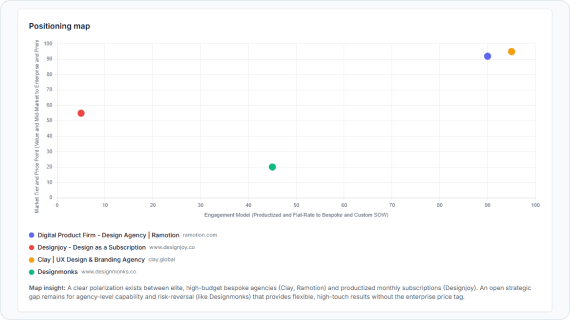
Use the positioning map to compare competitors and explore gaps worth validating.
Share a dossier by link or export a branded PDF for your next strategy conversation.
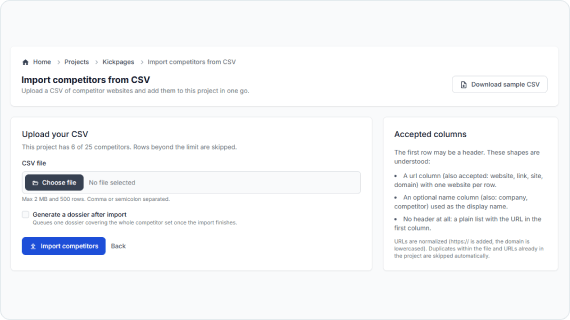
Bring competitor lists in with CSV import. Connect your workflow through the API and webhooks.
Inside CompetitorTool
Real screens from the product—from choosing competitors to acting on market changes.
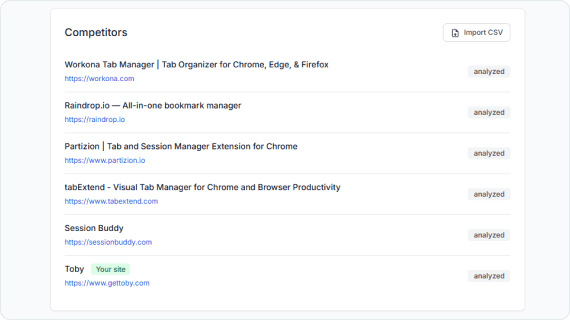
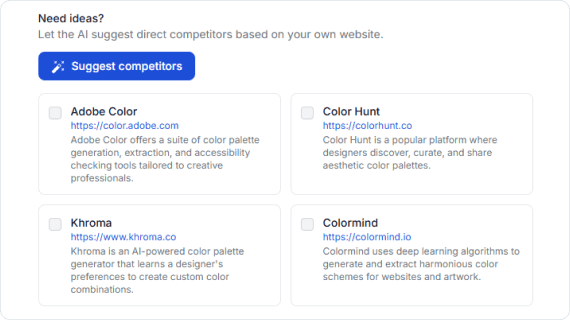
Build the market view
Add websites yourself, import a CSV, or let AI suggest businesses worth reviewing. Keep every competitor organized inside the right project.
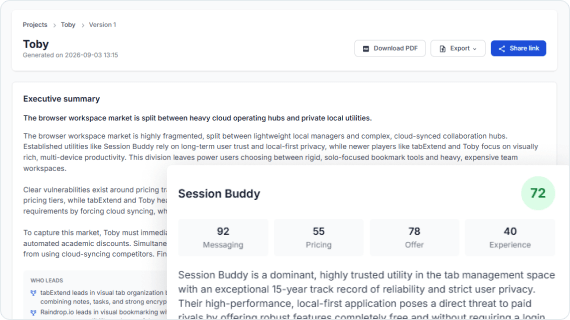
Turn research into clarity
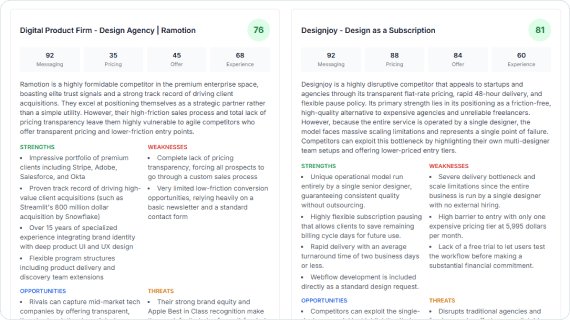
Review executive summaries, competitive scores, SWOT analysis, pricing, and positioning without piecing the story together across dozens of tabs.
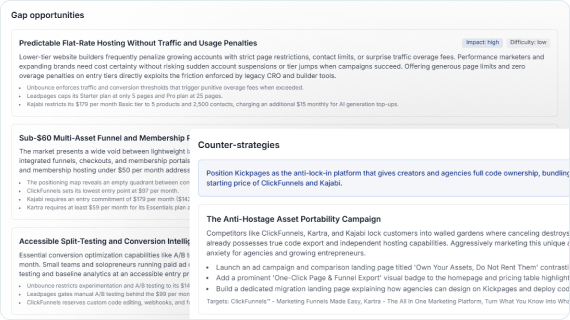
Find the opening
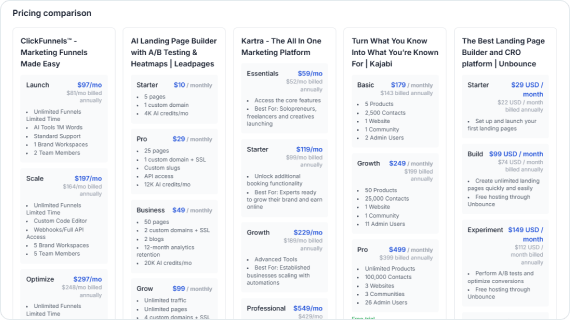
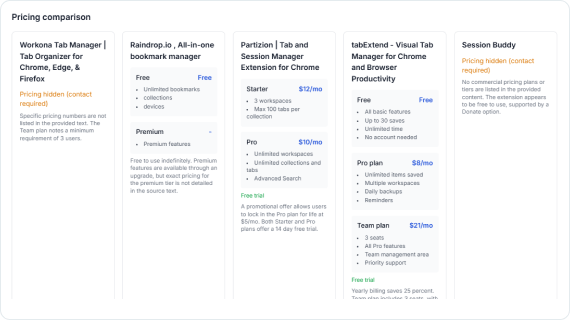
See pricing structures side by side, identify under-served needs, and turn the most promising market gaps into concrete counter-strategies.
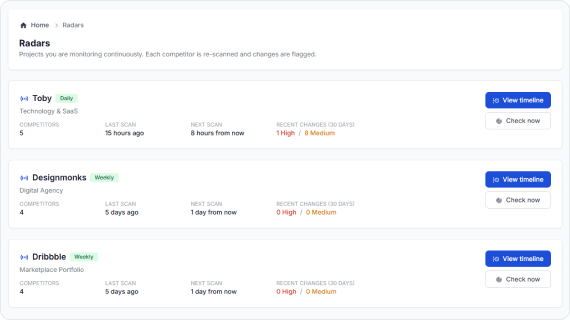
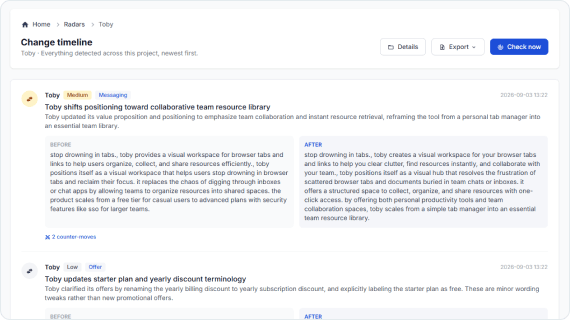
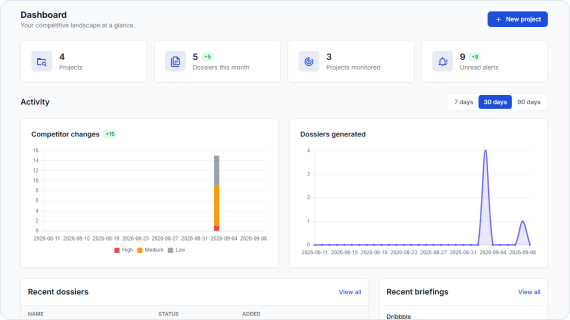
Keep watch automatically
Schedule monitoring, review change timelines, and open the dashboard to see which shifts deserve your attention now.
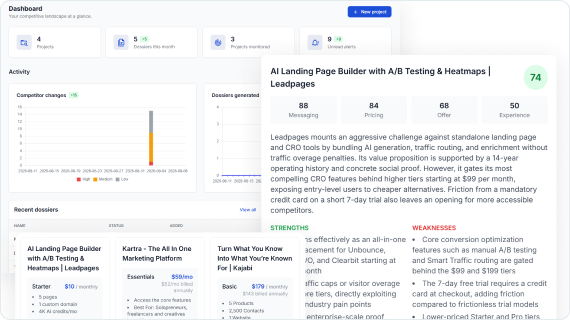
Screens show real product workflows. Example competitor data may change as public websites change.
03 / Stay in the picture
Build a habit of competitive awareness, without rebuilding your research from scratch.
Schedule re-scans to track shifts in pricing, offers, and messaging. Review changes by significance.
Use change history and briefings to see what moved and why it may matter.
Develop offer copy, landing page sections, social posts, and emails. Review and adapt the suggestions before publishing.
Change detected
A competitor now includes onboarding in its premium package.
Offer updateWhy it could matter
Buyers may be comparing the help they receive, as well as the price they pay.
Suggested response
Clarify what customers get in their first week. Show the process, not just the promise.
Illustrative workflow. Detection follows your scan schedule.
Built for the decisions on your desk
You don’t need a research department
to ask better competitive questions.
Explore where existing offers fall short and which differences could matter to your next customer.
Review your pricing, offers, and messaging with the competitive landscape in view.
Bring structure to the research and explain why a proposed change is worth testing.
Your next move starts here
Get the full competitive intelligence system for one payment, backed by a 30-day money-back guarantee.
Get the core power of CompetitorTool for life while bringing your own compatible AI API key. Your AI usage is paid directly to your API provider.
Regular price$297$97Early bird price · USD · one time
No recurring CompetitorTool subscription.
Get lifetime accessPayPal checkout is currently unavailable.
30-day money-back guarantee.
A few useful answers
CompetitorTool organizes competitor research into dossiers, SWOT analysis, and actionable recommendations. It helps you understand how competitors position their offers and identify ideas worth exploring for your own business.
It’s built for founders, small business owners, and lean teams that need a more structured view of their competition without making research a full-time job.
Start with your business and the websites of the competitors you want to understand. A focused competitive set makes the findings easier to compare and act on.
The Early Bird Lifetime plan requires you to connect your own compatible AI API key after signup. You pay the API provider directly for your AI usage; the $97 early-bird payment covers your lifetime access to CompetitorTool under the listed plan limits.
It gives you suggested actions and the reasoning behind them. You bring the customer knowledge and business context. Treat recommendations as ideas to evaluate and test, rather than guaranteed outcomes.
Monitoring follows your configured scan schedule. A change can be detected after a re-scan, so timing depends on the schedule and the accessibility of the competitor’s website.
Yes. CompetitorTool comes with a 30-day money-back guarantee, so you can evaluate it for your business.
Review the underlying evidence and check important details before making decisions. Public websites can be incomplete or change, and AI analysis can make mistakes. A market gap is a starting point for validation, not proof of demand.